
WHAT THE PRIMARY IS
The work of the small child is to build himself.
Our Primary classroom is a Montessori environment in the tradition Maria Montessori herself laid out — a mixed-aged community of children ages three through six, working in long uninterrupted periods in a carefully prepared environment with AMI-approved materials, led by a trained guide, in an atmosphere of order, beauty, and reverence.
The Primary serves children at the most formative stage of their lives — the years when the patterns of attention, courtesy, and concentration that will carry them through the rest of their schooling are first being set. We take that responsibility with the seriousness it deserves.
WHAT TO EXPECT
Hallmarks of the Program
I.
Practical Life
Pouring, polishing, sweeping, folding, table-setting, buttoning, food preparation. The first work the child takes up is the care of himself and his surroundings — the foundation of every later discipline.
II.
Sensorial
Materials that refine the senses one quality at a time — the pink tower, the sound cylinders, the color tablets, the geometric solids — train the eye, ear, and hand before the abstract work begins.
III.
Mathematics
Number rods, sandpaper numerals, the golden-bead material, the stamp game. Children move from the concrete to the abstract and, by the end of the Primary, can perform addition, subtraction, multiplication, and division.
IV.
Language
Sandpaper letters, the moveable alphabet, phonics work, and the first reading and writing. Children typically write before they read, and write in cursive from the start.
V.
Geography
Globe and continent puzzles, country maps, flags, and the names of the seas. Children learn the world by tracing it with their hands before they read it in a book.
VI.
Science
Living plants in the room, life-cycle work, the parts of the leaf, the parts of the body, the classified animal cards. The natural world is studied directly — and named precisely.
VII.
History
Calendars, the days of the week, the months, the seasons, time-line work, and the birthday celebration — a walk around the sun. The child's first sense of time is given a frame.
VIII.
Art
Drawing from observation, watercolor, clay, and the metal insets that prepare the hand for writing. Beauty is woven into the daily work, not set aside for an art period.
IX.
Music
Singing, the bells, rhythm work, and the first chant — including a Latin hymn or two by the end of the Primary. Music is a daily part of the room, not a once-a-week visit.
X.
Catechesis of the Good Shepherd
The Catholic life of the Primary is formed in the atrium — a prepared space where children meet the Lord through Scripture, parable, and the materials of the liturgy.
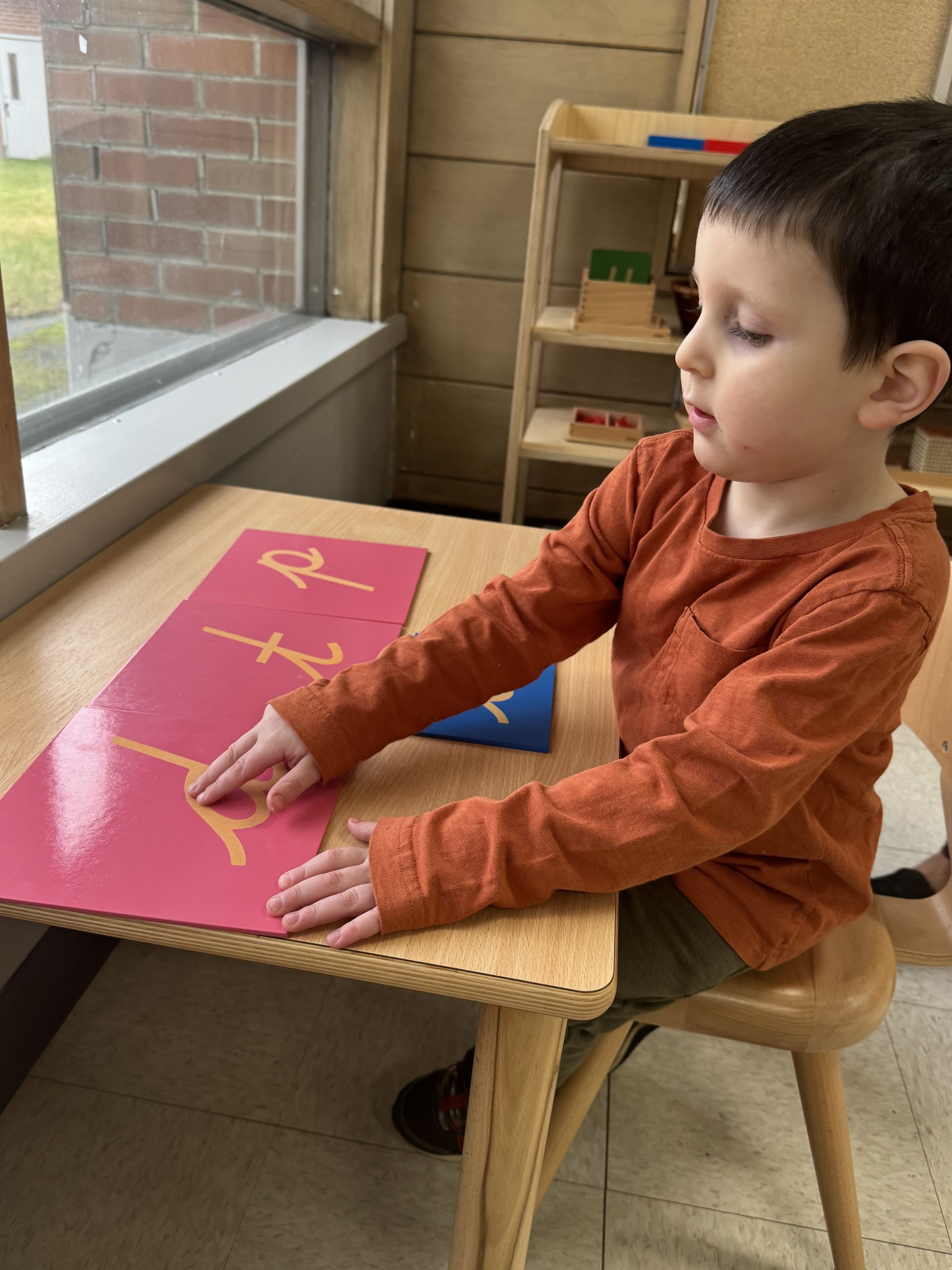
A Primary child tracing the sandpaper letters
A DAY IN THE MONTESSORI PRIMARY
What the morning looks like.
The Primary day begins with a brief gathering and then opens into a long, quiet morning of independent work. Children choose materials from the shelf, work for as long as the material engages them, and return what they have finished. The guide circulates, gives individual lessons, and observes.
Late morning the class gathers for grace before lunch and a meal taken together at small tables. After lunch, the older children continue with academic work; the youngest take a quiet rest.
GOALS OF THE PRIMARY CLASSROOM
What a child is able to do by the end of the Primary.
By the end of our Montessori Primary at Saint Charles Borromeo, most children are writing in cursive with ease and are able to read simple stories of their own creation, which they enjoy illustrating with a drawing or a watercolor painting. They understand the mathematical operations of addition, subtraction, multiplication, and division — and know many math facts by heart — as well as the names of the continents, of countries, of animals, and of plants.
Just as importantly, they are accustomed to working independently for long stretches, to caring for the room and its materials, to speaking politely with adults and children alike, and to taking their place — small but real — in the worship of the Church.
See Our Montessori Program in session.
Primary visits are by appointment, in small groups, during the morning work cycle. The classroom does not change for visitors — it is the only way to see it as it really is.